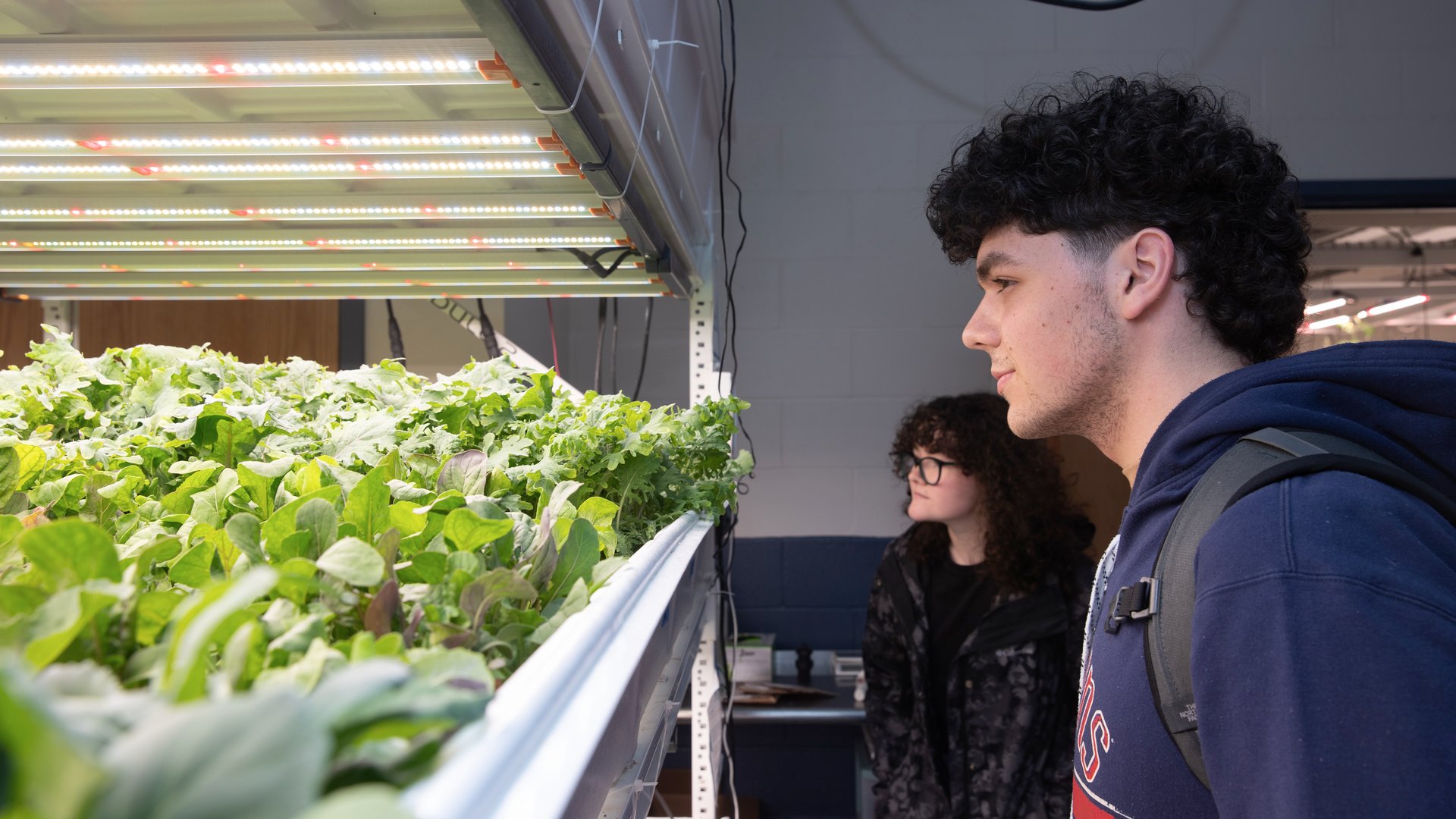
In Armstrong Hall at The College of New Jersey, growing continues even through winter. The campus Indoor Ag Lab is designed for year-round production, using a tightly controlled setup that can raise microgreens, herbs, lettuces, berries, tomatoes, and peppers without relying on soil or sunlight.
The College of New Jersey is part of the EPIIC project, Managing Culture Change on Two Fronts — Strengthening Our Capacity to Develop Partnerships. With an aim to be recognized as a true partner in New Jersey’s innovation ecosystem, TCNJ is strengthening its capacity to build and sustain cross-sector collaborations.
A Partnership Designed for Research and Community Impact
Indoor Ag (iA) Labs is a joint initiative between GeoGreens and The College of New Jersey’s Schools of Engineering and Science, offering a high-tech, accessible space for research in hydroponics and indoor agriculture. GeoGreens is a local hydroponics company that has spent the past decade addressing food insecurity by supplying fresh produce to communities in food deserts.
Tackling the Hard Questions — Together
From the outset, the partnership has positioned the project as both a technical effort and a learning space, focused on finding efficient methods to accelerate growth and potentially improve nutritional value. With many variables to refine — especially how space and lighting are used — the lab gives students a place to test ideas, develop new approaches, deepen their learning, and contribute to the field.
The lab’s partners are explicitly inviting that interdisciplinarity. “We’re looking for people to come in and think, ‘I’d like to be involved with this effort.’,” said School of Engineering Dean Andrea Welker in a related article. “The interdisciplinarity of this work is what makes it so exciting.”
Early Momentum, with Practical Outcomes
Inside the 1,295-square-foot facility, the team has spent the past six months testing optimal growing conditions. The results are already tangible: The lab is producing about 150 pounds of fruits and vegetables per month and is expected to nearly double that output by the end of summer as student involvement increases. Where the harvest ends up matters, too: Part of the produce will stock the college food pantry, The Shop, and the remainder will be distributed to community members.
A Hub with Room to Grow
The iA Labs vision points beyond campus — toward research, education, and community engagement that can scale. As GeoGreens founder Desmond Hayes puts it: “It’s a hub agriculturally and for the community, too,” a place where students, faculty, and partners can keep refining what indoor agriculture can do — and who it can serve.